Fuck Ozempic: What Figure and Still Life Drawing Taught Me About Bodies, Healing, and Being Human

Updated: Aug 24
lAs a human, I am so fed up with seeing women of all shapes and sizes pop up on my social feeds, selling some form of GLP-1. Like, its absolutely exhausting. And so fucked up that almost every single woman I know, no matter their health, size, or diet, has been on a GLP-1 or heavily considered it. After being a witness to so much drastic body change in celebrities, Tik Tokers, and loved ones, I have honestly had to remind myself of what real, unaltered bodies look like. And not only that, but find the beauty in those bodies.
As an art therapist, I have spent years helping people heal their relationships with their bodies. Ironically, some of my greatest lessons about body image didn't come from therapy textbooks, eating disorder trainings, or social media activism. They came from drawing naked people.
Seriously.
Figure drawing quietly changed the way I see bodies. Long before I discovered Health at Every Size® (HAES), body liberation, or anti-diet work, figure drawing was teaching me something radical: bodies are not problems to solve. In a culture obsessed with shrinking, optimizing, correcting, and controlling bodies, figure drawing asks something completely different of us. It asks us to look. Not judge. Not improve. Not fix. Just look.
What Is Figure Drawing?
Figure drawing is the practice of drawing the human body from direct observation. Traditionally, artists work from a live model and focus on gesture, movement, proportion, anatomy, light, shadow, and form. Yet somewhere along the way, something unexpected happens. You stop seeing a body as attractive or unattractive, successful or failed, thin or fat. Instead, you begin seeing shape, movement, texture, weight, balance, tension, softness, strength, and story.
A scar becomes texture. A belly becomes shadow. A stretch mark becomes line. A body becomes a landscape. The longer I practiced figure drawing, the harder it became to participate in the cultural lie that some bodies are inherently more worthy than others.

I remember being introduced to nude figure drawing for the first time in college. I received my art degree from an all women's catholic college in northern Indiana. You might think the opinions and attitudes on this campus would be horrified by the idea of exposing young women to nudity, however it was quite the progressive environment. After a slew of female models, varied in shape and size, we came across our first nude male model. And for a group of all women, freshman, and honestly horny as fuck students, this was incredible. This was life changing. This... was a competition.
The male model seemed on the younger side, especially compared to the 82 year old man we had the following week (quite the drop in excitement in comparison). I believe there were rumors of him being a graduate student at the brother university across the street. All I know is, my classmates, who I am used to seeing show up to class with hair in a greasy ponytail, shorts, and an oversized t-shirt, were now showing up to Figure Drawing 101 with full make up, hair curled, and eyelashes twirled. There was an unspoken tension that I could feel in my shoulders and lower back as I noticed each girl attempt to engage the model in conversation while drawing his nude form. It was so interesting to see how each girl leaned over their drawing horse to expose collar bone, shoulder, or cleavage.
Meanwhile, I had a direct view of this dude's taint and every time one of these girls made him laugh, I had to erase parts of my drawing to reposition the way his flaccid dick laid across his thigh. I remember thinking, huh... it would be more interesting to me to observe and draw my classmates than this guy's ever moving penis. I wanted to capture the beauty in each of my classmates, the extent to which they changed themselves for the male gaze, and most of all, the diversity of faces, bodies, and colors amongst them all.
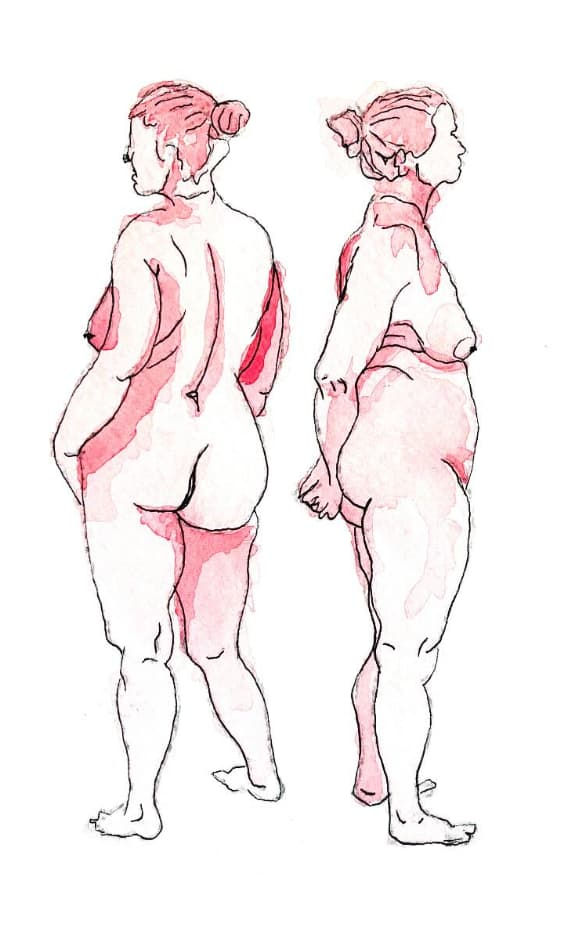
Figure Drawing Through a Health at Every Size Lens
One of the core principles of Health at Every Size is that body size does not determine someone's worth, humanity, beauty, or value. Figure drawing naturally teaches this lesson. When you spend hours observing bodies of different ages, sizes, genders, abilities, races, and identities, diversity stops being theoretical and becomes undeniable. Bodies are supposed to vary. Bodies are supposed to change. Bodies are supposed to age. Bodies are supposed to carry evidence of living.
Through repeated observation, the nervous system begins learning something many of us were never taught: there is no such thing as a "correct" body. This kind of learning is different from reading an Instagram post about body positivity. It becomes embodied knowledge. The lesson enters through the eyes, hands, and nervous system. You experience body diversity rather than simply agreeing with it intellectually.

Fuck Ozempic (Or More Accurately, Fuck the System That Convinced Us Our Bodies Need Fixing)
Let's get something out of the way. My issue is not with people who take Ozempic, Wegovy, or other GLP-1 medications. Healthcare decisions are personal. Bodies are personal. What concerns me is the cultural obsession surrounding these medications and what it reveals about our collective relationship with bodies.
The message is everywhere: become smaller. Take up less space. Be more desirable. Be more acceptable. Be more worthy. Be for the male gaze. And somehow we're expected to call this health.
From an intersectional feminist perspective, this conversation isn't actually about weight loss. It's about power. Historically, systems of oppression have always attempted to regulate bodies, particularly the bodies of women, femmes, queer people, disabled people, and people living in larger bodies. Diet culture, beauty culture, wellness culture, and now pharmaceutical culture often profit from the same underlying belief: that our bodies are projects, that we should always be improving, and that we are never enough as we are.
The beauty industry profits from insecurity. Diet culture profits from self-hatred. Social media profits from comparison. Increasingly, pharmaceutical companies profit from our fear of remaining in the bodies we already have. What if the problem was never our bodies? What if the problem was a culture that taught us to distrust them?
As a therapist, I watch people spend years (and a shit ton of money!) believing happiness exists twenty pounds away. I watch brilliant, compassionate humans postpone their lives until they become thinner. And honestly? I'm exhausted of it.
Figure drawing became one of the practices that helped me resist that narrative. When you spend enough time truly observing real human bodies, the fantasy body disappears. What remains is humanity. Wrinkles. Scars. Fat. Muscle. Stretch marks. Asymmetry. Survival. Bodies stop being projects and start becoming stories.

The Neuroscience of Learning to Observe
One of the reasons observational drawing can feel surprisingly therapeutic is because it changes how attention functions. Trauma pulls our attention toward threat. Anxiety pulls our attention toward the future. Shame pulls our attention toward self-criticism. Observational drawing asks us to do something entirely different.
Notice the shadow. Follow the contour. Observe the angle. Stay present.
From a neuroscience perspective, figure drawing engages visual-spatial processing, sensory awareness, motor planning, attention networks, and present-moment focus. Rather than becoming trapped in rumination, self-criticism, or hyper vigilance, attention is repeatedly redirected toward direct observation. The nervous system shifts from evaluation to curiosity, from threat detection to exploration, and from judgment to noticing. That shift matters.

What Is Still Life Drawing?
Still life drawing involves drawing objects from direct observation. These objects might include flowers, fruit, shells, personal belongings, fabrics, medical objects, or collections of meaningful items. Like figure drawing, still life drawing is not primarily about artistic skill. It is about attention.
Unlike expressive art-making, which often emphasizes emotional expression, observational drawing encourages clients to slow down and engage with what is directly in front of them. The goal is not perfection. The goal is presence.
Still Life Drawing During Trauma and Cancer Treatment
One of the most powerful examples of this occurred while working with a client undergoing treatment for breast cancer. She was navigating chemotherapy, a double mastectomy, uncertainty, grief, fear, and profound changes in her relationship with her body. Like many people facing serious illness, she often felt as though her body had become a problem to manage rather than a place to live.
Some days, emotional processing felt impossible. The medical system demanded enough from her already. She didn't always have the energy to unpack another feeling. During these periods, we incorporated still life drawing into our sessions. Sometimes she drew flowers. Sometimes meaningful objects. Sometimes items that represented comfort, resilience, or hope.
The drawing itself became secondary. The process became everything. For brief moments, attention shifted away from scans, lab results, surgeries, side effects, and uncertainty. Instead, the nervous system received a different invitation: notice the light, observe the edge, follow the curve, stay with this moment. From a trauma-informed perspective, this process supported regulation without requiring disclosure. She did not need to explain, analyze, or justify her experience. The artwork created a structure for simply being present. And sometimes that was enough.

Observation as Resistance
One of the central injuries of trauma is narrowed attention. The world becomes smaller, more rigid, and more threatening. Observational drawing gently expands the field again. It supports present-moment awareness, nervous system regulation, curiosity, mindfulness, cognitive flexibility, embodied awareness, and sustained attention.
In art therapy, healing does not always occur through expression. Sometimes healing occurs through witnessing. Through slowing down. Through learning how to see.

Seeing Ourselves Differently
Figure drawing taught me that bodies are not projects. Still life drawing taught me that observation itself can be healing. Together, these practices continue to remind me that art therapy is not always about expressing feelings or creating symbolic images. Sometimes it is about helping people reconnect with the present moment and with themselves.
In a world obsessed with optimization, transformation, and self-improvement, observational drawing offers something surprisingly radical: the opportunity to stop fixing, stop judging, and simply see.
And sometimes, being seen—by ourselves, by another person, or through the act of art-making itself—is where healing begins.
Further Reading & References
Bombak, A. E. (2014). Obesity, health at every size, and public health policy. American Journal of Public Health, 104(2), e60–e67. https://doi.org/10.2105/AJPH.2013.301486
Brown, K. W., & Ryan, R. M. (2003). The benefits of being present: Mindfulness and its role in psychological well-being. Journal of Personality and Social Psychology, 84(4), 822–848. https://doi.org/10.1037/0022-3514.84.4.822
Cook-Cottone, C. P. (2015). Mindfulness and yoga for self-regulation: A primer for mental health professionals. Springer.
Hinz, L. D. (2020). Expressive therapies continuum: A framework for using art in therapy (2nd ed.). Routledge.
King, J. L. (2016). Art therapy, trauma, and neuroscience: Theoretical and practical perspectives. Routledge.
King, J. L. (2024). The neuroscience-informed art therapist: A practical guide to art therapy and neuroscience. Routledge.
Levine, P. A. (2010). In an unspoken voice: How the body releases trauma and restores goodness. North Atlantic Books.
Menzel, J. E., Schaefer, L. M., Burke, N. L., Mayhew, L. L., Brannick, M. T., & Thompson, J. K. (2010). Appearance-related teasing, body dissatisfaction, and disordered eating: A meta-analysis. Body Image, 7(4), 261–270. https://doi.org/10.1016/j.bodyim.2010.05.004
Piran, N. (2016). Journeys of embodiment at the intersection of body and culture: The developmental theory of embodiment. Academic Press.
Rothschild, B. (2017). The body remembers: The psychophysiology of trauma and trauma treatment (2nd ed.). W. W. Norton & Company.
Siegel, D. J. (2020). The developing mind: How relationships and the brain interact to shape who we are (3rd ed.). Guilford Press.
Tribole, E., & Resch, E. (2020). Intuitive eating: A revolutionary anti-diet approach (4th ed.). St. Martin's Essentials.
Tylka, T. L., Annunziato, R. A., Burgard, D., Daníelsdóttir, S., Shuman, E., Davis, C., & Calogero, R. M. (2014). The weight-inclusive versus weight-normative approach to health: Evaluating the evidence for prioritizing well-being over weight loss. Journal of Obesity, 2014, 983495. https://doi.org/10.1155/2014/983495
van der Kolk, B. A. (2014). The body keeps the score: Brain, mind, and body in the healing of trauma. Viking.
Warren, C. S., & Akoury, L. M. (2020). Embracing fatness: Examining body acceptance and resistance to weight stigma. Body Image, 34, 37–43. https://doi.org/10.1016/j.bodyim.2020.05.001


Comments